You Used to Own Every Song You Loved. Now You're Just Renting Them by the Month.
The Wall of Records That Told Your Story
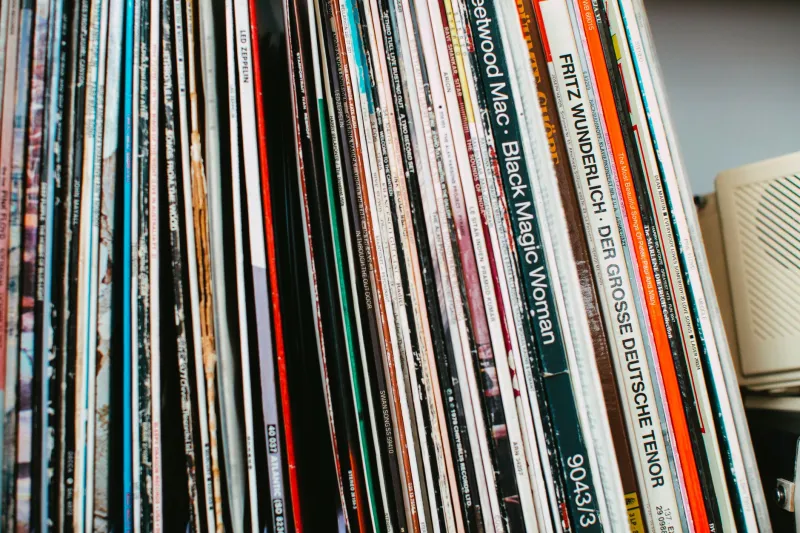
Walk into almost any American home between the 1960s and the late 1990s, and you'd find it: the collection. Maybe it was a wall of vinyl albums, dog-eared sleeves stacked in milk crates. Maybe it was a tower of cassette tapes labeled in someone's handwriting. By the mid-nineties, it was probably a rack of jewel cases, alphabetized or organized by mood or era — depending on the person.
That collection wasn't just music. It was autobiography. You could look at someone's shelves and understand something true about them — the phase they went through in college, the breakup that produced a suspicious cluster of sad albums, the road trip mixtape they still hadn't filed properly. Music was a physical artifact, and owning it meant something.
Today, most Americans under 35 have never owned a single song in any meaningful sense. They've streamed billions of them, sure. But ownership? That's a different thing entirely.
What It Actually Meant to Buy an Album
When you bought a record or a CD, you made a commitment. You spent real money — often $15 to $20 for a new release — and brought something home that was yours permanently. You read the liner notes on the subway. You memorized the track order. You made decisions about which albums were worth the shelf space and which weren't.
That friction was meaningful. It made you pay attention. When a band released something disappointing, you felt it personally — you'd already spent the money and carved out the space. When they released something great, the physical object in your hands felt like a reward.
The economics were straightforward, even if they weren't always fair to artists. You paid once. You owned it forever. Your kids could inherit it. Your copy of Born to Run or Purple Rain would still play perfectly in thirty years, assuming you didn't scratch it to death first.
The Streaming Bargain: Everything, All the Time, Until You Stop Paying
The streaming era arrived with a pitch that was genuinely hard to argue with. For around ten dollars a month — less than the cost of a single new CD — you could access virtually every album ever recorded, instantly, on any device. No storage problems, no scratched discs, no lost jewel cases.
Millions of Americans took that deal, and who could blame them? The convenience was extraordinary. The catalog was unimaginable. By any rational measure, a Spotify or Apple Music subscription delivers more music than any physical collection ever could.
But somewhere in that transaction, something quietly disappeared.
When you stream music, you don't own any of it. You're licensing access to a catalog for as long as you keep paying and as long as the platform keeps the rights. Albums vanish from streaming services when licensing deals expire. Artists pull their catalogs in disputes. Platforms shut down entirely — remember Rdio? Grooveshark? The music you've been listening to for three years can be gone by Tuesday morning, and there's nothing you can do about it.
More subtly, the relationship between listener and music has changed. Streaming algorithms are extraordinarily good at serving you songs you'll probably enjoy. They're less good at challenging you, surprising you, or pushing you toward something uncomfortable that might become your favorite record in six months. The discovery process has been outsourced to machine learning, and the machine is optimized to keep you listening — not necessarily to change your life.
The Playlist Replaced the Album, and That Matters More Than You Think
The album as an artistic unit is quietly dying. Streaming platforms reward individual tracks because listeners skip freely and algorithms favor songs that hold attention in the first thirty seconds. Artists increasingly release singles or loosely connected collections rather than cohesive long-form works designed to be heard start to finish.
That's a genuine cultural loss. Some of the most important moments in American music history were album experiences — Thriller, Nevermind, Lemonade — works where the sequence and the context were part of the meaning. When you shuffle-stream those records, you lose something the artist specifically designed for you to have.
The generation that grew up buying albums understood this instinctively. Younger listeners often don't have a frame of reference for it, which isn't their fault — it's just the water they swim in.
The Numbers Tell an Interesting Story
In 2023, streaming accounted for roughly 84% of all music industry revenue in the United States. Physical media — vinyl, CDs — made up less than 10%. Digital downloads, once seen as the future, are nearly extinct.
Vinyl has seen a genuine resurgence among enthusiasts, with sales growing for 17 consecutive years through 2022. But even that revival is largely nostalgic and niche. The mainstream has moved decisively to access-based models, and there's no realistic path back to a world where most Americans maintain personal music libraries.
What that means economically is also worth noting: the average American music fan spends roughly $120 a year on streaming subscriptions. In 1999, the average household spent around $70 annually on music purchases. Adjusted for inflation, we're paying more than ever — and accumulating nothing.
What We Actually Gave Up
None of this is an argument that streaming is bad. The convenience is real, the access is genuinely remarkable, and the idea of returning to a world where you had to physically locate and purchase every song you wanted to hear sounds exhausting.
But it's worth being honest about the trade. We exchanged permanence for convenience, ownership for access, and the friction that made music meaningful for frictionless consumption that sometimes makes it feel disposable.
Your grandfather's record collection survived moves, marriages, and decades. Your streaming playlist will disappear the moment you miss a payment or the company changes its terms of service.
That's not just a practical difference. It's a philosophical one. And it says something real about how we've come to think about the things we love — not as possessions to be kept, but as services to be subscribed to, until we decide to subscribe to something else.