Your Neighborhood Druggist Was Half Doctor, Half Therapist. Then Corporate America Took Over.
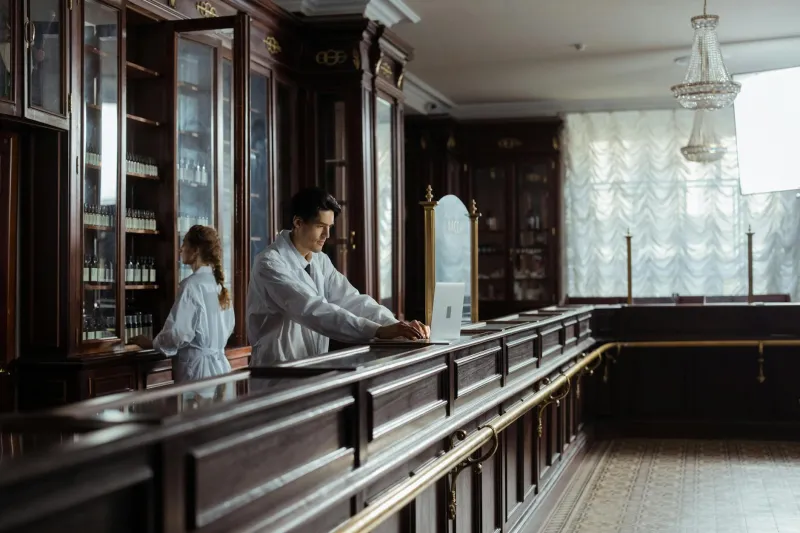
When Your Pharmacist Was Your Neighbor
Walk into any CVS or Walgreens today, and you'll likely encounter a harried pharmacist behind bulletproof glass, racing to fill hundreds of prescriptions while customers wait in increasingly long lines. It's efficient, sure, but it's also completely anonymous. Your pharmacist probably doesn't know your name, let alone your medical history or family situation.
This wasn't always the case. For most of American history, the neighborhood pharmacist occupied a unique position in healthcare—part medical advisor, part confidant, and wholly invested in the wellbeing of their community.
The Corner Drugstore's Golden Age
In the 1950s and 1960s, most Americans got their prescriptions filled at independent pharmacies owned by pharmacists who lived in the same neighborhoods as their customers. These weren't just pill-dispensing operations; they were healthcare hubs where the pharmacist knew not just your name, but your kids' names, your chronic conditions, and often your financial situation too.
Take Harold Weinstein, who ran Weinstein's Pharmacy in Brooklyn from 1947 to 1983. He kept handwritten index cards for every customer, noting their medications, allergies, and even personal preferences. When Mrs. Rodriguez came in with a prescription that might interact with her heart medication, Harold caught it immediately—not because of a computer alert, but because he remembered her medical history.
These pharmacists often provided informal medical advice that went far beyond their prescriptions. They recommended over-the-counter remedies, explained how medications worked, and sometimes even spotted potential health problems before doctors did. Many kept blood pressure cuffs and would check customers' vitals for free.
The Personal Touch That Saved Lives
This intimate knowledge wasn't just nice—it was often lifesaving. Independent pharmacists regularly caught dangerous drug interactions, dosing errors, and medication mix-ups that computer systems might miss. They knew when elderly customers hadn't picked up their medications in a while and would call to check on them.
More importantly, they served as accessible healthcare advocates for people who couldn't afford frequent doctor visits. In working-class neighborhoods, the pharmacist was often the most medically knowledgeable person families could afford to consult. They'd recommend when someone really needed to see a doctor and when a simple over-the-counter remedy would suffice.
The relationship was built on trust that developed over years or even decades. Customers felt comfortable asking sensitive questions about their health, discussing side effects, and seeking advice about family medical concerns.
When Everything Changed
The transformation began in the 1970s and accelerated through the 1990s as chain pharmacies expanded aggressively. Walmart, CVS, Rite Aid, and Walgreens could offer lower prices through volume purchasing and streamlined operations. Independent pharmacies, unable to compete on price, began closing at an alarming rate.
By 2000, chain pharmacies controlled over 60% of the market. Today, that number exceeds 80%. The remaining independent pharmacies often struggle to survive, squeezed between insurance reimbursement cuts and corporate competition.
The chains brought undeniable benefits: longer hours, more locations, better inventory management, and sophisticated computer systems that track drug interactions and allergies. Prescription errors decreased, and medications became more accessible to more people.
The Rise of the Pharmacy Machine
Modern chain pharmacies operate more like factories than neighborhood health centers. Pharmacists are under intense pressure to fill prescriptions quickly—often 300 or more per day. There's little time for consultation or relationship-building. Many locations now use automated dispensing systems and even robotic filling machines.
The personal touch has been largely replaced by technology. Computer systems flag potential drug interactions, print medication guides, and track prescription histories across multiple locations. It's more systematic and arguably safer in many ways.
But something important was lost in translation. Today's pharmacists, despite their extensive training, function more as medication verification specialists than healthcare advisors. The bulletproof glass that separates them from customers symbolizes the new reality: efficiency over intimacy.
What We Gained and Lost
The modern pharmacy system excels at scale and consistency. You can fill prescriptions at any location in a chain, access your medication history instantly, and benefit from sophisticated safety protocols. Insurance processing is streamlined, and generic alternatives are readily suggested to save money.
However, we've traded away the human element that once made pharmacy care deeply personal. The pharmacist who knew your family's medical history, who could spot concerning patterns, and who served as an accessible healthcare resource has largely disappeared.
This shift reflects a broader change in American healthcare—toward efficiency and standardization, but away from personal relationships and community-based care. While we've gained access and consistency, we've lost the pharmacist who knew not just our prescriptions, but our stories.
The Prescription for Connection
Some independent pharmacies still exist, offering glimpses of what we've lost. They provide medication synchronization services, home delivery for elderly patients, and the kind of personal consultation that chains simply can't match with their current business models.
As healthcare becomes increasingly impersonal, perhaps there's value in remembering what the neighborhood pharmacist once provided: expert medical knowledge wrapped in genuine human care. In our rush toward efficiency, we might have filled our prescriptions but lost something essential—the healing power of being known.