America Used to Fix Things Until They Fell Apart. Now We Just Buy New Ones.
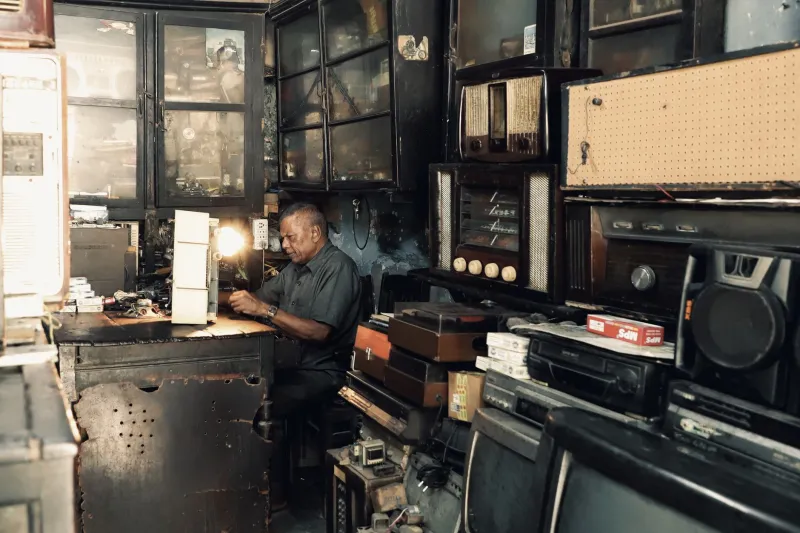
In 1962, if your television set stopped working, you didn't throw it away. You couldn't afford to, and frankly, the thought probably wouldn't have occurred to you. You called the TV repairman — and in most American towns, there was absolutely a TV repairman — who showed up, opened the back panel, swapped out a vacuum tube or two, charged you a reasonable fee, and left you with a working television. The set might last another decade. Maybe two.
That same year, Americans spent more on repair and maintenance services than on any other household service category. Fixing things wasn't a hobby or a virtue. It was just what you did.
Today, the average American generates about 4.9 pounds of trash per day — nearly double the rate of the 1960s. When a cheap Bluetooth speaker stops working, almost nobody calls a repair shop. They order another one from Amazon and have it by Thursday.
The Repair Economy That Built a Country
For most of American history, the infrastructure of fixing things was woven into the fabric of every neighborhood. Cobblers resoled shoes until the leather gave out entirely. Tailors and seamstresses kept clothing in rotation for years. Appliance technicians made house calls for washing machines, refrigerators, and radios. Furniture restorers refinished tables that had been in families for generations. Watch repair shops occupied corners in every mid-sized American city.
This wasn't just sentiment — it was economics. Consumer goods were expensive relative to wages, and the labor to repair them was comparatively cheap. A new refrigerator in 1955 cost the equivalent of several weeks of an average worker's salary. Paying a repairman a fraction of that to keep it running was a straightforward financial decision.
There was also a cultural dimension. The generation that lived through the Great Depression and World War II had a visceral relationship with scarcity. You fixed things because waste was morally uncomfortable. You kept things because replacing them felt reckless. The phrase "use it up, wear it out, make it do, or do without" wasn't a Pinterest quote — it was an operating principle.
The Moment Everything Changed
The shift didn't happen overnight, but it accelerated sharply through the 1970s and 1980s as global manufacturing — particularly from Japan, and later China — drove the price of consumer goods down dramatically. When a new toaster costs $19.99, paying a technician $45 to fix the old one stops making obvious sense. The economic logic of repair started to collapse.
Manufacturers noticed. And here's where the story gets a little less innocent. Rather than simply benefiting from lower production costs, many companies began deliberately designing products with shorter lifespans — a practice that would eventually acquire the clinical name "planned obsolescence." Components became harder to access. Screws were replaced with proprietary fasteners. Glue replaced screws entirely. User manuals stopped including repair diagrams.
By the 1990s, electronics had become essentially unrepairable by design. The circuit boards inside a DVD player were miniaturized to the point where consumer-level repair was nearly impossible. The message, implicit but clear, was that repair was for professionals — and professional repair cost more than replacement.
The repair shops started closing. Slowly at first, then in waves. The Bureau of Labor Statistics stopped tracking "radio and television repairers" as a meaningful occupational category in the early 2000s because there simply weren't enough of them left to count.
What We Lost Beyond the Obvious
The environmental toll is the part that gets the most attention, and it deserves it. Americans discard roughly 50 million tons of electronic waste globally each year. Landfills have absorbed decades of appliances, electronics, and clothing that could have been repaired, repurposed, or at minimum responsibly recycled. The fast fashion industry alone produces an estimated 92 million tons of textile waste annually worldwide, and the U.S. is among the largest contributors.
But there's another loss that's harder to quantify. The repair economy was also a local economy. The cobbler, the TV repairman, the seamstress — these were small business owners embedded in their communities. Their income stayed local. Their skills were specialized and respected. The collapse of repair culture didn't just change consumer habits; it hollowed out a category of skilled neighborhood commerce that hasn't been replaced.
There's also something subtler about how we relate to the things we own. When you've had a pair of shoes resoled twice, you have a relationship with those shoes. When you've watched a repairman coax another year of life out of your washing machine, you feel something different about that appliance than you do about its disposable replacement. Ownership used to carry a kind of stewardship. Now it mostly carries a warranty period.
The Right to Repair Fight
It would be wrong to say nobody is pushing back. The right-to-repair movement has been building quietly for over a decade, and it's started winning some notable battles. The basic argument is straightforward: if you own something, you should have the legal right to fix it — or to take it to whoever you choose for repair — without voiding warranties or running into software locks that prevent independent service.
In 2021, the FTC issued a report supporting right-to-repair principles. Several states have passed or are considering legislation requiring manufacturers to make repair manuals and parts available to consumers and independent repair shops. Apple, John Deere, and other major companies have faced significant pressure — and in some cases lawsuits — over repair-restrictive practices.
It's a start. But it's also a fight that wouldn't need to exist if the design philosophy of American manufacturing had never abandoned repairability in the first place.
A Different Kind of Progress
There's a version of this story where disposability is simply the cost of abundance — where cheap, accessible consumer goods democratized comfort in ways the repair economy never could. That's not entirely wrong. Not everyone could afford a quality appliance in 1955, and the availability of low-cost goods has genuine value.
But somewhere between the Depression-era ethos of "fix everything" and today's "replace everything" culture, something useful got discarded along with the broken stuff. The idea that objects have lives worth extending. That skilled repair work is valuable. That ownership comes with some responsibility for what you own.
America built its identity on resourcefulness. It might be time to remember what that actually looked like.